Showing posts with label Yogyakarta. Show all posts

Saturday, February 19, 2011

Does Vagina Chalk Really Exist?

Via Via is one of my favorite restaurants in Yogya. Calling itself a 'travelers' cafe', it not only offers up a delicious mix of world cuisines and live jazz on Friday nights but it also organizes interesting sightseeing trips around town using local forms of transportation. One of the tours on offer is the 'Jamu Tour'.


Jamu is the word for traditional herbal Indonesian medicines and you can see jamu sellers all over town - these women are easily recognized by the big woven baskets of traditional medicine they carry around strapped to their backs. And yes, they're always women. This is because women are believed to have magical powers for making jamu - a carefully concocted blend of bark, leaves, roots, and fruit used to heal an array of ailments.

Anastasia, Melanie, Michaela and Jackie and I headed down to Via Via early one morning to meet our tour guide in front of the restaurant. We were interested in learning more about the traditional medicines but we were even more intrigued by the existence of something called vagina chalk. Apparently, there is a special stick of chalk that Indonesian women insert into their vaginas before sex to make themselves drier. Say what?! Yes, apparently, Indonesian men desire their women to be dry because that means they are more virtuous or something. We simply had to find out more about this.

After meeting our guide, we climbed into our three awaiting becaks, a type of bicycle rickshaw, and headed off to the local market to visit the stall of a woman who sells jamu ingredients. We stood around her stall for a good long while sampling the many fruits and leaves she had to offer. Then we piled back into our becaks and went to the house of a retired jamu seller to see these raw ingredients transformed into a special elixir.

Jamu ingredients for sale at the local market

Anastasia and Jackie in a becak

Anastasia paints a sticky rice face mask on Melanie.

Turmeric and asam are ground together for our jamu.

Jamu maker and her final product - a jamu juice to relieve menstrual cramps
All of this facial mask making and turmeric juice sampling was fine and good but when we got back to Via Via we begged our tour guide to tell us about the 'sexy' jamus we had heard about. She laughed, disappeared inside the store and reappeared a few minutes with this box of questionable items.


Note the 'Worldy Stick of Joy'!! A.k.a. 'vagina chalk' this was the item we had only heard rumors about before. And now here it was. It really exists! Women really use this!!

Vagina chalk!
The box was filled with all sorts of interesting powder and capsule jamus. There were jamus to increase sexual stamina for men, tighten the vagina, and even ones for 'late menstruation' i.e. abortion. We weren't tempted to buy anything but later one of Michaela's friends commented on her blog, "If you get me anything - anything at all [from Indonesia] - it has to be the Vagina Chalk."


Thursday, February 17, 2011

Ancient Temples of Borobudur & Prambanan

The Buddhist temple of Borobudur and the Hindu temple compound known as Prambanan are Yogyakarta's most popular tourist attractions. Although one is Buddhist and the other Hindu, these two places of worship have very similar histories. Both were built in the ninth century, abandoned shortly thereafter, and devastated by disaster and neglect for centuries. Today both are UNESCO World Heritage Sites and are right in my backyard.

I visited both of these sites for the first time in September and then again in February when my ELF friends Jackie and Michaela came to visit. We left the ICRS guesthouse at 5:30 in the morning to beat the heat and the crowds. Our efforts paid off because we had Borobudur practically all to ourselves on a gloriously sunny morning. But by the time we got to Prambanan, the midday sun was at its strongest and we felt ourselves fading fast and in need of some frozen mango drinks at Parsley. However, before we called it a day we got in some great photo-ops and learned some interesting facts.

The origins of the name 'Borobudur' are disputed 
but it might mean 'temple above the hill'.

Borobudur was abandoned in the 10th century
 and remained buried under volcanic ash until its rediscovery in the 18th century.

Borobudur is Indonesia's most visited tourist attraction.

There are 2,672 relief panels representing Buddhist cosmology 
from the lusty everyday to Nirvana.
Originally there were 504 Buddha statues.
Today more than 300 are damaged and more than 40 are missing.

One of the few intact Buddha statues. Many statues were decapitated soon after Borobudur's rediscovery in the 18th century. The heads can be found in museums all over the world.
There are more Buddha statues inside each of these latticed stupas. This top level of the temple was closed because the Buddhas in the stupas are still covered in ash from the recent 2010 eruptions of Mt. Merapi.

Like Borobudur, Prambanan was abandoned in the 10th century, probably because of a volcanic eruption, and  was further damaged in a big earthquake in the 16th century. Proper restoration began in the 20th century but earthquakes remain a constant threat. The main temple is still closed to visitors today because of the 2006 Yogya earthquake.
Four-headed Hindu statue in one of the smaller shrines.

Sunday, November 21, 2010

A Medical Mystery

For the past few months, I have been troubled by an array of odd symptoms and even odder medical advice. It all started the day my plane landed back in NJ after my first ten months in Indonesia. I noticed that the right side of my body sometimes felt very strange - a little bit numb, some tingling sensations - and felt colder than the left side of my body. And then the left side of my mouth started drooping! Alarmed, I went to see a doctor at home who ended up sending me for an MRI to rule out the possibility of MS. The MRI came back normal and the doctor concluded my symptoms must be caused by stress. This seemed to be a cop out answer to me since there was nothing in my life that I was feeling particularly stressed about. But in any event, my symptoms lessened and I returned to Indonesia feeling relatively fine.

However, by the beginning of October I was forced to acknowledge that I really wasn't fine. The odd sensations and mouth drooping were back, I felt unusually tired and lightheaded at the end of the day, I was having trouble gripping things in my right hand and, most disturbingly, there was a period of two to three days when I experienced really bad headaches that made my head feel like it was going to explode. These shooting pains in my head scared me enough to confide in Ingrid and seek out a doctor in Yogya. Ingrid did some research and took me to a doctor that several people had recommended.

Unfortunately, this doctor in Yogya turned out to be a bit wacky. His initial assessment of me was done through iris imaging. We looked at pictures of my eyes on a TV screen and he told us how spots on the iris correlated to organs of my body. My heart and lungs were fine but he mentioned in passing that I have a dirty left ovary. I'm sorry, what? A dirty left ovary?? But I quickly forgot about this as he announced his provisional diagnosis. According to him, I had a 'viral infection on a nerve in the brain'. Yikes! A brain infection?? And he can tell this by looking at pictures of my eyes? I was doubtful, but he ordered some blood work done and I figured a blood test would probably be a more reliable measure.

So the next day Ingrid and I went back to see him about the results of the blood test. He glanced at the paper we handed him from the lab and he announced that I have rubella. Really? I knew I had been vaccinated against rubella as a child and I didn't have a rash so this struck me as odd, but perhaps there was an Indonesian strand of the virus that I did not have immunity against. What do I know; I'm certainly not a doctor. Anyway, he prescribed two different medications, 6 to 12 rounds of physiotherapy, a detoxifying ionic foot bath (more on that in a minute) and last but not least he wanted me to wear a cervical collar for a month to put my facial muscles back in place. A cervical collar!! I asked him many questions but I could tell he was getting impatient. Ingrid translated that he felt like he was giving a lecture. He ended our session by saying that if I had any more questions I should just Google them. I promised myself I would do just that as soon as I got home, but first there was the experience of the ionic foot bath.

The ionic foot bath consisted of a tub of cold water with some sort of metal device that was plugged into a machine. The guy in charge (the attendant, the technician?) explained that the impurities from my body would float out of my feet and collect on the surface of the water as a layer of scum. Well, those weren't his exact words but that was the idea. If the scum formed one circle that meant I was relatively healthy. If the scum formed separate circles, it meant there was a problem somewhere. I peered into the tub; three distinct circles had formed. The guy looked at me sadly and shook his head. He told me the best thing to do in my case was to pray. Then he held up a worn copy of an English language book entitled 'Alone with God' and asked me if I wanted to read it. I politely declined and high tailed it out of there with Ingrid. I'm not saying prayer won't help, but it's not exactly what I wanted to hear at the doctor's office!

Back in my room, I Googled 'rubella' and found out that the blood work I had gotten done tested positive for the presence of IgG rubella antibodies, which should be present since I was vaccinated. I had tested negative for IgM rubella antibodies, which would have indicated that I currently had the virus. I sat there dumbfounded by the idea that the doctor I had gone to see had misinterpreted a simple blood test like this. On the spot I discounted everything he said to me - which to be honest was kind of hard to swallow anyway - and wrote to my RELO supervisors to see what I should do next. They suggested I fly to Jakarta to see a more reputable doctor at the International SOS Clinic.

On the day of my flight to Jakarta I found out that the neurologist I was scheduled to see had to cancel because of an emergency surgery. At the last minute RELO was able to get me another appointment with another neurologist at a Jakarta hospital. This doctor listened to what I had to say, did a few physical tests and told me I had migraines. Now, migraines sounded much more plausible than rubella but it still didn't ring true for me. I had been experiencing all these weird symptoms for over three months and only had one bout of bad headaches. And there was no aura or sensitivity to light or noise or any of the classic other migraine symptoms. I also didn't care for his recommendation of avoiding cheese, chocolate, coffee, citrus and cola. No cheese?? That's a horrible, horrible thing to forbid a girl who spent her twenties in a country famous for its cheese and who was cheese deprived for the entire 10 months she spent in Gorontalo.

To get a second opinion, I booked another appointment with the SOS doctor that I was originally supposed to go see. Of the three doctors I saw, Dr. Amanda did the most thorough testing and questioning. In fact she was so thorough that she sent me to get more extensive blood work done, an EEG and two evoked potentials tests called VEP and SSEP. The SSEP test was horribly painful. My body was hooked up to all sorts of electrodes and tortured with a vibrating current. It was most painful in my feet.

When the lab doctor wordlessly handed me her report at the end of the session, all I saw where the following words in bold type on the top of the page: Diagnosis: Multiple Sclerosis. At first I was stunned. Oh no!! And then I was angry. Who does that??? Who hands somebody a diagnosis of MS without saying a word about it?? It was shocking and I spent the taxi ride back to Jackie's quietly contemplating my fate and calling my parents. By the time I got back to the apartment I was visibly upset when I told the other girls. But Megan, to whom I will be forever grateful, calmed me down and explained that this was probably just a bad translation. A better wording would have been something like this: Reason for Test: Possibility of Multiple Sclerosis. Megan also pointed to the conclusion section of the report which said nothing about MS and just stated that the test results were compatible with sensory neuropathy in both lower extremities. What did that mean? Well, I had to wait another week or so before I could go back for a follow up appointment with Dr. Amanda.

When I finally got to sit down again with Dr. Amanda, I learned that I have a calcium deficiency. I had grown up knowing that I should drink milk for strong bones but I never realized before or had forgotten that calcium ions transmit messages from one nerve to the next. My decreased level of calcium was slowing these transmissions and causing nerve pain! Dr. Amanda speculates that I depleted my calcium stores living in Gorontalo where I pretty much involuntarily eliminated milk, cheese and broccoli from my diet. Never underestimate the importance of cheese! No wonder I craved pizza practically every time I left Gorontalo. My body was literally crying out for it. To fix this, Dr. Amanda prescribed me some calcium/vitamin D supplements and B12 supplements for good measure. I also asked her if there were any specific foods I should be eating as well, thinking she might say something like milk or cheese. But instead she replied, "Bone." Bone?!?! Bone has never been a diet staple in the part of the world where I'm from. She clarified by explaining that those little tiny fish that Indonesians dry and salt are a very good source of calcium. Right. Dried whole fish. Sounds yummy!

I tried the dried fish one night with some nasi goreng. They tasted just like bacon!
After months of worrying about what could be wrong with me, I'm relieved to find out it's something as simple and treatable as a calcium deficiency. I'm so glad it's not MS or migraines or a 'brain infection'. I just need to eat more cheese...and bone!

Wednesday, November 17, 2010

Escape from Merapi

In mid-October I moved into a new cubicle at ICRS. The new office space has tons of advantages: it's much bigger than my previous cramped quarters; it's centrally located in the hub of all ICRS activity so I don't feel like I'm all alone in the building when five o'clock rolls around; it's right next to Ingrid and Ipung's desks so I can easily chat, ask questions and steal some warm pisang goreng from Ingrid; it's close to the coffee and tea supply; and perhaps most impressively, it boasts a great view of Mount Merapi on a clear day. I thought it was pretty darn cool to have an office with a view of a volcano but on Oct 22 I noticed that the volcano seemed to be smoking. I pointed this alarming fact out to Ingrid, who told me that it's normal to see smoke coming from Merapi since it's an active volcano but also reassured me that we had nothing to worry about.

When I came home from work on Oct 25, I learned from my housemate Anastasia, who's always on top of the news, that experts were predicting an imminent eruption of Mount Merapi and had already started evacuating nearby villages. We sat glued to the TV that night, wondering what might happen next. The very next day, Oct 26, Merapi started to erupt, spewing ash and rocks into the air. That night found all of us once again glued to the TV in the common room as we watched the ash-covered evacuees talk to local reporters. A light ash rain fell in the background as people wearing face masks huddled together. I couldn't help but wonder why the shelters were so close to the volcano. Why weren't these people being taken farther away? Like to Yogya, a city about 25 km away and out of the danger zone where we were just comfortably sitting around watching the events unfold on TV?

I got the answer to my question the next day at work when Ipung explained to me that the villagers were reluctant to move far away from their cattle and livestock on the slopes. These animals represented their sole means of earning a living; if the animals died, so would their livelihoods. The men felt a strong need to stay close to their homes so they could run back and check on their cows during periods of low volcanic activity. If the authorities had insisted on evacuating these people farther away, they probably would have refused to evacuate at all.

I also learned that day that the eruption had already claimed a number of lives, including that of an elderly man known as Mbah Maridjan who was regarded as the spiritual guardian of the volcano. For many years, Mbah Maridjan's responsibility was to appease the gods of the 'Fire Mountain' with offerings of rice or flowers. Locals believed that if a serious eruption was imminent, Maridjan would be warned in a vision. On Oct 26 he stubbornly chose to ignore official orders to evacuate. His ash-covered body was later found in a praying position. Tragically, 13 other bodies of people who had either followed his example of staying despite evacuation orders or who had tried to persuade him to leave were found as well, including those of a journalist and a Red Cross volunteer. News of his death spread quickly through ICRS and saddened many.


Mount Merapi as seen on Oct 27 from my office window

On Oct 28 I flew to Jakarta. No one had ordered me to evacuate; I just happened to have a doctor's appointment. I also had plans to stay out of town for the next two weeks because of a conference in Bandung, the Marine Ball in Jakarta and another workshop in Banda Aceh. My timing couldn't have been better. The day after I arrived in Jakarta I started to get frightening reports from friends back in Yogya: Merapi had erupted two more times, the airport was shut down, and the volcanic ash had reached Yogya - it even dusted our guesthouse. Merapi was nowhere near being done erupting. In fact, she was just gathering energy. I was glad to be out of harm's way, but I worried for those still in Yogya.

On Nov 5 I woke up to the following text message from my counterpart, "Julianne, don't get back to Jogja first, Mt Merapi is getting worst. Ipung." A text from RELO followed shortly thereafter asking all ELFs to confirm our locations and to warn us to stay away from Mt Merapi, Yogya and Solo. It turns out that in the early morning hours of Nov 5 there had been what the media was calling the "worst eruption of the century". This eruption would eventually push the death toll up from 44 to over 250 and counting and triggered a series of emergency actions: my host university canceled all its classes for the week and many of UGM's buildings were converted into shelters for displaced people; the Indonesian government promised they would reimburse farmers for the loss of their cattle in an effort to convince them to stay away from Merapi's deadly slopes; and AMINEF pulled the ETAs out of the region and temporarily relocated them to Jakarta. In the days immediately following the eruption, I heard tales of intense rain, lightening and even a 5.6 earthquake in Yogya (said to be unrelated to Merapi, but still).

There have been no major eruptions since Nov 5, the danger zone has decreased in some areas and classes have resumed at UGM and ICRS. However, Merapi continues to cough and rumble. How long this will go on is anyone's guess. Ingrid and Ipung report that Yogya is feeling normal again but on Nov 10 the U.S. State Department issued a travel alert for the area until Dec 31. The ETAs have been moved from Jakarta to work indefinitely at other schools on Java; Demi is now in Bandung and Brett is in East Java.

As for me, I'm stuck in Jakarta for the time being. My original flight back to Yogya was scheduled for Nov 14 but the Yogya airport is closed until Nov 20. But even then, is it safe to go back? Demi tells me that AMINEF is keeping the ETAs out of the region until the Indonesian government officially lowers Merapi's alert status. Consequently, RELO is checking with the Embassy Regional Security Office about when it will be safe for me to return. In the meantime, I'm being put up in nice hotels in Jakarta and RELO is giving me various little projects to work on. Yesterday I was a guest visitor in an Access Microscholarship Program English class. I'll return tomorrow to lead the class through some speaking and writing activities. On Friday and Saturday I'm volunteering to help interview Indonesian high school students for a year-long exchange program in the U.S. These are interesting tasks, but I hope it will be safe enough for me to return to Yogya soon to resume my life and regular classes there. It's not easy being in this state of limbo and uncertainty and I miss my friends and housemates in Yogya.


Wednesday, September 29, 2010

Teaching Academic English

I've finished my first month of teaching! Well, perhaps I should clarify that by saying that although I've finished teaching for the month of September, I've only actually taught four classes. My first week at ICRS was spent settling into my office and modifying the syllabus put together by Amber last year so that I could actually teach it. Then I went off to Bali for 10 days for the Idul Fitri holiday. And then I came back to teach my awesome schedule of only two classes per week. So now that I have this first month (or 4 classes) under my belt, I thought it was time to give an update on my teaching situation this year.

Let's backtrack to my first week at ICRS. I spent most of this week being alternately extremely grateful for all the files that Amber had left behind and also super intimidated by the work she had done. She was the first ELF at ICRS and she literally wrote the book on the academic writing curriculum here. Seriously. She WROTE A TEXTBOOK as part of her project last year. And while I was very thankful for all her groundwork and clearly labeled folders and documents on the hard drive, I also grew increasingly worried that I was in over my head. Amber is a PhD student in Rhetoric and Composition. Not too surprisingly, her extremely thorough syllabus is peppered with jargon from her field: discourse communities, genre analysis, rhetorical sequence, rhetorical situation, summary reminder phrases, and rhetorical prospectus. Fear raced through me as I read over her syllabus for the first time. How was I supposed to teach students to write a rhetorical prospectus if I didn't even know what that term meant? And, I wondered, if I had trouble understanding the terms on her syllabus, how did her students feel?

Fortunately, a nice long chat about expectations with my counterpart Ipung helped calm me down. Taking into account that my background is in TESOL, not rhetoric and composition, and also considering the feedback from last year's students who felt they had more work then they could handle in the academic writing class, Ipung and I decided that I could tweak the syllabus a bit. So, I went back to the drawing board and hashed out an adapted version of Amber's syllabus that I felt much more comfortable teaching. I took out the year-long research paper project (complete with annotated bibliography, lit review, and rhetorical prospectus) and focused instead on 4 distinct assignments each semester. This term I'll have my students write a personal literacy narrative, a summary of a religious studies article, a reaction paper and a final writer's reflection paper. Next term, I'll assign an editorial and response, a comparative summary of two religious studies articles, a book review and a film critique. Then they'll have a final publication project where they select and polish two pieces of writing from the year to be published and distributed to all members of the class and the ICRS office. My hope is that my students will see my class as a workshop where they can get comfortable with the conventions of writing in academic English. For most, this semester will be their first experience doing so since their bachelor and master's degrees were entirely in Indonesian. (As a side note, all ICRS classes are conducted in English. ICRS is an international, interreligious PhD program that attracts applicants from all over the world.)

Even after feeling good about my changes to the syllabus, I was still nervous for the first day of class. I was about to step foot into my first classroom of PhD level students. Many of them are currently lecturers at other universities on Java and have published numerous articles and books (in Indonesian) on religious studies, a field I know extremely little about. My students are Muslim, Buddhist and Christian and are comfortable tossing around buzzwords like 'interfaith dialogue'. This is completely new territory for me. Luckily, our first few sessions together have gone extremely well. There are only 12 students in the class and they all seem very approachable and eager to learn about academic English. I have a feeling that I will learn just as much from them this year about religious studies and 'interfaith dialogue' as they will (hopefully) learn from me about academic writing in English.

As part of the course, my students are required to come see me at least once per assignment for a 30 minute individual consultation session. This is a time where we can talk about the feedback they have gotten from their peers, the revisions they are working on, grammar points they want to clarify and anything else that comes to mind. I've had a handful of sessions so far and was, in a sense, relieved to hear that my students are still looking for help with things like prepositions and thesis statements. These requests I can handle, since they're much more within my realm of experience than, say, research proposals or rhetorical moves.

To finish this post, I'd like to share a funny anecdote from a recent individual consultation session. The student came in, sat down and handed me the first draft of his essay. I glanced over it and asked him, "Do you have any specific questions about this essay?" To my surprise, he started listing the places he had visited in America. He rattled off numerous states and even mentioned attending some sort of month-long program in Hawaii. I listened politely while trying desperately to figure out the connection between his list of places visited in America and draft 1 of his essay. Finally, he stopped and said, "No, I've traveled a lot there. I don't think I have any specific questions about the USA."

Sunday, September 5, 2010

Dining Out in Yogya

I'm writing this post while drinking my second cafe latte of the morning, having just finished a big Sunday brunch consisting of an omelet, toast, chicken sausage, melon and baked beans. Oh yeah, and I just ordered a chocolate croissant to go with my second cafe latte.  What's more, I'm connected to the internet because this cafe has fast and free wi-fi! And all I had to do to get here was walk down the street from my guest house. Ooohhh...my croissant just arrived and it's even warm! I think I might make Sunday brunches at this cafe a regular event. Few things make me as happy as the prospect of a delicious meal.

I am truly in culinary heaven here in Yogya. I spent the past week checking out the various restaurants around town with Ingrid and my housemates. Highlights included spinach fettuccine and a tomato and mozzarella salad at Via Via, a chicken and mushroom brick-oven pizza followed by tiramisu at Nanamia, guacamole with toast and a spinach pancake with homemade cheese and mushrooms at Milas, chicken korma and pumpkin soup at Sangam House, and even a delicious 3 mushroom creamy fettuccine with garlic cheese bread at the Pizza Hut down the street. Italian, Indian, American....I definitely won't starve here!

This is a big relief, since, as followers of this blog know, Indonesian cuisine seldom whets my appetite. That said, the other day Anastasia, John and I were wandering around the kampung by the university looking for a place that was actually serving lunch during Ramadan and stumbled upon a great little warung that had a whole menu of tasty Indonesian options. I ordered nasi goreng tuna (fried rice with tuna) and terong goreng tepung (eggplant fried in flour). Even though both dishes were fried, they were surprisingly delicious! I washed it all down with a fresh strawberry juice, happy that I just found what might become my new regular lunch place.

Sunday, August 29, 2010

Seafood Feast at Depok


After touring the Sultan's Water Palace, we were all in a water sort of mood and spontaneously decided to head to the ocean for a seafood dinner. We settled into the van for a one hour ride that turned out to be only 40 minutes since our driver drove like a maniac dodging motorbikes right and left. Thankfully, we survived that ride and found ourselves on a relatively uncrowded black sand beach just in time for sunset. We had arrived at the INDIAN OCEAN!

With Anya and Anastasia

Zipping around on an ATV seemed to be the thing to do

Sunset!


I had heard that the seas south of Yogya were rough and they certainly looked it. Thunderous waves crashed in every direction and no one was swimming although there were a few Indonesian guys splashing around, tempting the Queen of the South Seas. I was content to stand at the water's edge and let the warm water and black sand cover my feet as I watched the waves crash and roll. I'm glad Yogya isn't far from the ocean. Depok is one of the closest beaches to the city and Ingrid and Anastasia raved about the fresh seafood market here.

Ingrid selected a tasty sampling of seafood at the market for us to try. We carried our bags of seafood to a little warung on the beach where it was cooked up for us as we walked along the water. We feasted on grilled tuna, fried shrimp, squid, clams, grilled snapper, and crabs. The grilled tuna and the fried shrimp were particularly delicious.

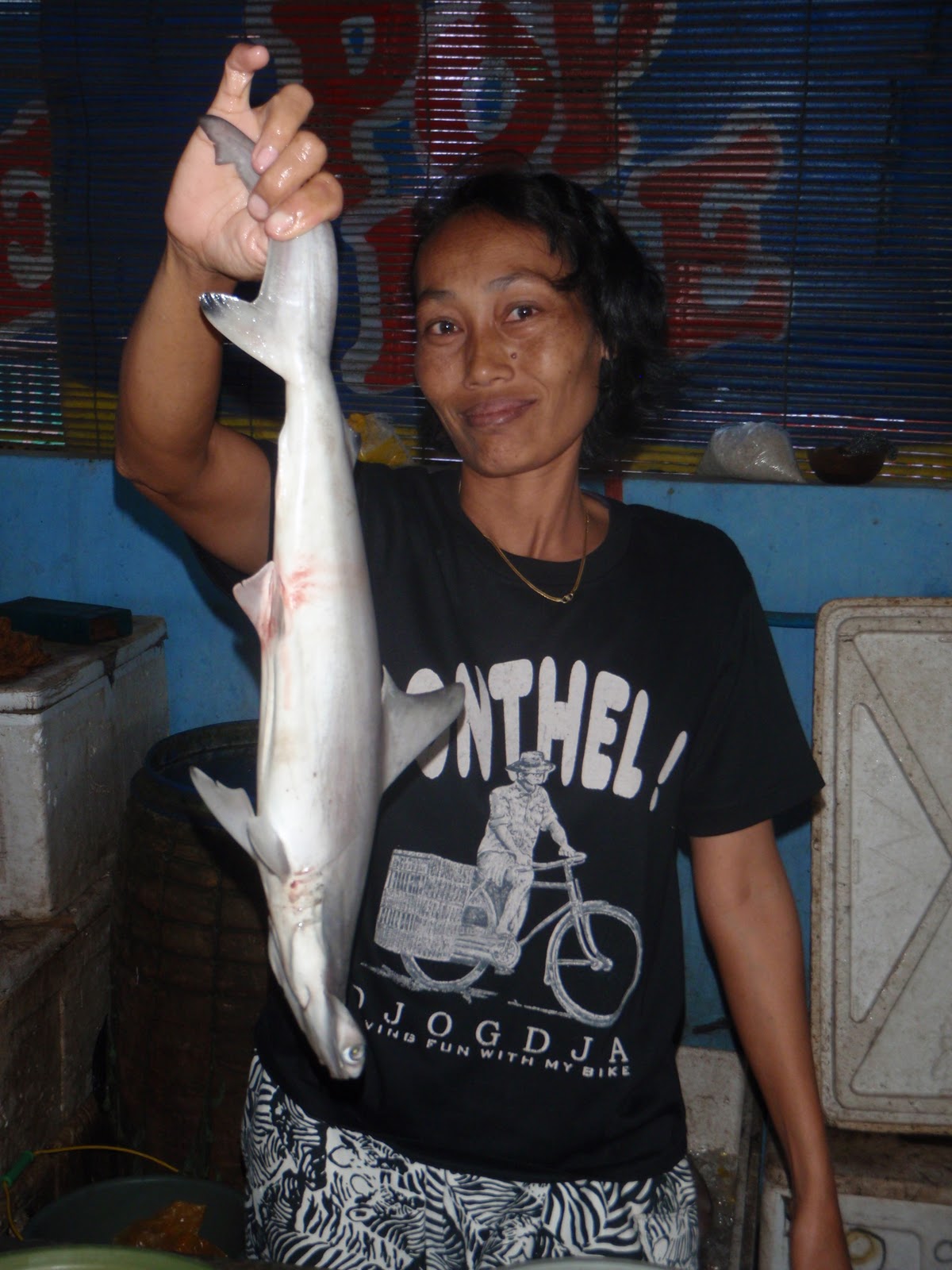
The only dent in my enjoyment of the evening was seeing that there were baby sharks for sale at the seafood market. I was particularly affected by the sight of a baby hammerhead shark. When I was on Bunaken for my rescue diver course, my instructor was a major shark guy who showed all of us a presentation that he does on shark awareness. His gist is that sharks are amazing creatures, not man-eaters, and most importantly, they are the alpha predators of the ocean and without them the oceans will collapse. He detailed the problematic indiscriminate fishing of sharks, particularly in Asia, in a very thoughtful talk. He has reached many people in South East Asia with his presentation but clearly there is a long way to go with environmental education in Indonesia. Seeing a local woman proudly holding up a dead baby hammerhead shark is, sadly, not at all unusual in this part of the world.

Poor baby hammerhead

The Sultan's Water Palace

At ICRS, Ingrid, Amber's AWESOME counterpart from last year, is in charge of organizing cultural activities for Luce Fellows and anyone else who happens to be staying at the ICRS guest house, including me, Anastasia and Anya. These excursions happen, from what I gather, almost every weekend. Yesterday we were going to go to the Sultan's Palace but when we arrived we found out that it had closed early that day because of Ramadan. So, we modified the plan and went instead to visit the ruins of the Sultan's Water Palace, also known as Taman Sari. This was a place I had been really intrigued by, so I'm glad it turned out to be our first outing.

Completed in 1765, the Taman Sari complex is a huge area adjacent to the regular palace that the royal family used for relaxation, entertainment and even education in the form of lessons for the royal children. The main palace was destroyed in an earthquake in 1865 but the Sultan's private bathing area has been restored. The whole area is pretty much devoted to sensual pleasures. The very first courtyard we entered contained 4 pavilions for gamelan orchestras. Our guide joked that having not one but four orchestras was the original definition of surround sound. Growing in this courtyard were also trees with sawo and kepel fruit. Sawo fruit is eaten by men and is supposed to give them superhero powers at night. Everyone chuckled at this, but our guide was quick to point out that the superhero powers were not confined to the bedroom but to any physical task a man might have to do in the evening. Kepel fruit is eaten by women to help them produce sweet smelling sweat AND it's believed to have anti-conception powers. I suppose this was very useful considering the Sultans had many wives. 

Going down the stairs from the gamelan/fruit courtyard, we entered the bathing area. There were two large pools here- one for the children and one for the Sultan's wives. As the wives bathed below, the Sultan would watch them from his tower and then select the one he fancied sleeping with by throwing down a flower into the pool next to the chosen woman. Then, the wife would join the Sultan for a swim together in the Sultan's private pool behind the tower. We also peeked into the Sultan's bedroom in the tower. Interestingly, sandalwood was burned under the bed to help ward off mosquitoes and keep the Sultan smelling good. 

View of the wives' pool and the tower.

Ingrid and Anya at the Sultan's private pool

Saturday, August 28, 2010

Real World Academia Begins!

I arrived in Yoga late Wednesday evening in a mini-van sized taxi with my NINE pieces of luggage. I had two giant suitcases, a small suitcase, a duffel bag full of diving and swimming stuff, a small wheeled carry-on bag, my laptop bag, a bag with my mattress pad from Gorontalo, the large framed Wayang Kulit shadow puppet figure on goat skin and, finally, my purse. My counterpart, Ipung, and Mas Marwan, who works at the guest house, miraculously whisked all of this up a narrow spiral staircase to my new bedroom. I cringed as I watched them carry the enormous suitcases up the stairs. Then I met John, a Luce Fellow from California studying religion and Arabic, who is also living in the house for the semester and had just arrived the day before. He told me he had packed everything he needed for the semester in two CARRY-ON sized backpacks. I was awed and vowed (once again) that I really must learn to pack lighter.

Also living in the house is Anastasia, a Boren Fellow originally from New Hampshire. She has been here for two months already but had lived in both Yogya and Bandung before. She is such a blessing. I've been relying on her to for basic information such as where the spare toilet paper is kept in the house and where to go eat. She also full of interesting information about Yogya and Bahasa Indonesia. Case in point, while walking to the university yesterday she told me and John how the Indonesian word for freckles literally means 'fly shit'. And how the word for speed bump means 'sleeping policeman'. She's going to be here for 8 months studying the language. What a cool fellowship! Afterwards I think she is required to work for the State Department for a year. 

It's really great to have two other Americans living in the house. There's a third person here now too, Anya from Germany, but she'll be leaving next week. I haven't seen much of my counterpart since dinner the first night and a short meeting in my office yesterday about the upcoming semester. So it is FANTASTIC to have Anastasia, John and Anya to hang out on the front porch with, search for food with and to just have people around that I can relate to. In all my adult life since graduating college, I have never lived in a house or apartment with roommates. Well, I did live with a German family for 18 months in Switzerland but that was more of a host family situation than roommates. So, it's a novel experience to have people my own age around to do things with and explore the city with. 

Yesterday, Anastasia took John and me to Jl Malioboro where we walked down the most touristy street in Yogya filled with batik vendors and trinket sellers. Our destination was a particular store that offers a wide selection of good quality batik at fixed prices. This was convenient because my Indonesian is certainly not capable of sophisticated bargaining. Plus, what I wanted was a patchwork batik blanket exactly like the one Anastasia had gotten at that very store earlier this summer. So, we had a very successful mission. We wrapped up the day with a delicious dinner at Via Via, a Belgian owned restaurant known for its outstanding Indonesian and Western food. Plus, it's supposedly the one place in town where you can actually order a glass of wine ;-)

Wednesday, August 25, 2010

Moving to Yogya!

Tomorrow I'm moving to Yogyakarta!

When I decided to renew my ELF fellowship for a second year, I learned that I would have to relocate to another host site. Gorontalo was not going to be renewed for a third year. Having visited Yogya twice over the past year and knowing that the ELF project there was writing based, I asked my supervisor at the US Embassy if I could be posted in Yogya for my second year. Luckily for me he said yes!

Before I go on, here's a short excerpt from Lonely Planet for a bit of background information:

If Jakarta is Java's financial and industrial powerhouse, Yogyakarta is its soul. Central to the island's artistic and cultural heritage, Yogyakarta (pronounced 'Jogjakarta'), called Yogya for short, is where the Javanese language is at its purest, Java's arts at their brightest and its traditions at their most visible.

Fiercely independent and protective of its customs, Yogya is now the site of an uneasy truce between the old ways of life and the onslaught of modernity. Still headed by its sultan, whose kraton remains the hub of traditional life, contemporary Yogya is nevertheless as much as a city of cybercafes, lounge bars, and traffic jams as batik, gamelan and ritual. But while the process of modernization homogenizes many of Java's cities, Yogya continues to juggle past and present with relative ease, sustaining a slower, more conservative way of life in the quiet kampung that thrive only a stone's throw away from the throbbing main streets.

Yogya's potency has long outweighed its size, and it remains Java's premier tourist city with countless hotels, restaurants, and attractions of its own. The city is also an ideal base for exploring nearby attractions, including Indonesia's most important archaeological sites, Borobudur and Prambanan.

I'm thrilled that I'll be in Yogya this year, but before saying too much about why, I just want to say how much I'll miss Gorontalo. Gorontalo was not an easy place to get used to at first, but by the end of the year I really felt a strong connection to it, especially to the diving, Rantje, the whale sharks, my lovely students, the rice paddies, the fabulous sunsets, the misty mountains, the bentors, the candy colored houses and everything else. Yesterday I met Christina and Jolie, the new ETAs heading to Gorontalo, and felt both excited for them and sad for me that I won't be there. At least I'll be able to go back to visit.

Not only am I leaving the town of Gorontalo behind, but I'm also leaving the exotic, remote island of Sulawesi altogether and heading to Java, Indonesia's most populated and most developed island. A part of me longs to hold on the adventure and ruggedness that Sulawesi implies, but another part of me is also ready to embrace the comforts and sophistication of Java, especially Yogya.

I think my experiences in Yogya will be like night and day compared to Gorontalo. Just look at my housing situation for starters. Instead of being all alone in a house plagued with rats, power outages and a terrible internet connection, I am moving into what we affectionately dubbed 'The Palace' last year. My friend Amber (aka 'Princess') lived in a guest house belonging to the university. When we all descended upon the Palace for Thanksgiving last year, we were astounded at the Javanese wood furnishings, the wi-fi access, the hot showers, the goldfish ponds in the communal areas and the live-in help. And now I get to live there! Yes! I'm also looking forward to the fact that the guest house will host a rotating variety of international scholars throughout the year. It will be like Real World Academia. I've already been in email contact with an American woman named Anastasia, a Boren Fellow. And she mentioned that there's also a German woman staying at the house now. And then I learned from someone else that a Luce Fellow will be arriving soon. It'll be fun to have some interesting roommates.

Another big difference will be in the job itself. I'll be working at the Indonesian Consortium for Religious Studies, which is part of the graduate school of Gadjah Mada University. GRADUATE school. Just that fact alone implies that the students will be much better prepared for academic work than my plagiarizing undergrads in Gorontalo. At least I hope so. Also, Gadjah Mada or UGM is considered part of the Indonesian 'Ivy League'. When I went to visit Amber there last January, I was very impressed by everything from the quality of the facilities to the professionalism of the faculty and staff I met. My job will be to teach a writing class twice a week and then meet with students for individual consultations and tutorials to fulfill the rest of my 12 hours/week teaching requirement. I also think I'll be leading monthly movie sessions featuring films that deal with intercultural conflict.

And then there's the city of Yogya itself. I've heard that it's the second most visited place in Indonesia besides Bali. What that means for me is that in addition to the wonderful art scene and traditional culture, there will also be plenty of comforts that Gorontalo lacked.

Finally, as if Yogya weren't enough of a destination in itself, it's located very close to some other pretty spectacular places. To the west of the city lies the huge ninth century Buddhist temple of Borobudur that was unearthed only in 1815 after being quietly buried under volcanic ash for centuries. To the east are the ninth century Hindu temples of Prambanan. To the north is the mighty Merapi volcano, which garnered the following description in LP:

Few of Southeast Asia's volcanoes are as evocative, or as destructive, as Gunung Merapi (Fire Mountain). Towering 2911 m over Yogyakarta, Borobudur and Prambanan, this immense Fujiesque cone is a threatening, disturbing presence for thousands. The volcano has erupted dozens of times over the past century and some observers have theorized that it was even responsible for the mysterious evacuation of Borobudur and the collapse of the old Mataram kingdom during the eleventh century.

Lovely thought, huh? Locals routinely make offerings to appease the gods of the volcano as well as to the Queen of the South Seas who reigns over the Indian Ocean about an hour south of Yogya. The ocean waters here are reputedly dangerous but swimming is possible in protected fresh water pools and hot springs.

Overall, from my housing to my job to the availability of international cuisine to the lure of ancient temples and raging ocean swells, I think I will enjoy this new posting very much. I'm ready for this next chapter to begin.

Tuesday, January 26, 2010

On Workshops, Presentations and Conferences

Somehow I managed to survive the past two weeks of non-stop presentations. After my five presentations in Makassar, I flew directly to Java for five presentations in Yogyakarta and five more in Solo – which amounts to 2 weeks, 3 cities and 15 presentations. It was exhausting, but also surprisingly rewarding and entertaining.

One thing I like about presenting in Indonesia is that my audiences seem to genuinely appreciate what I’m sharing with them. Participants thanked me profusely for workshops I gave on Communication Repair Strategies, Learning Styles and Learning Strategies, Using Peer Reviews, and Developing Vocabulary Through Reading. In my mind, this is all very basic stuff, but to many of the participants this was cutting edge material. As an added ego-booster, many participants expressed an interest in having me come present at their own schools or universities or in contacting the RELO office so they can get an ELF of their own in the future.

I’ll also admit that I kind of like being treated as a celebrity guest speaker. I get chauffeured from venue to venue in a university sponsored car, I get taken out to dinner and shows and get put up in hotels, I pose for hundreds of photos with seminar participants, and I’m lavished with tokens of appreciation at closing ceremonies. I’m much more comfortable with this kind of celebrity than with, say, posing for photos with random strangers just because I’m a bule. At least at these seminars the people I’m posing with know who I am - even those who didn’t understand a single word of my presentation. And the gifts of appreciation are always interesting - in Yogya I received a beautiful handmade batik scarf while in Solo I received a giant framed painting of Krishna on a piece of furry goat skin!

When presenting in Indonesia there is always a high risk of cultural or organizational misunderstanding. In fact, this is pretty much guaranteed to happen so you might as well just go with the flow and try to see the humor in all of it. For instance, when I unpacked my photocopied handouts for my first set of workshops at a university in Yogya, I discovered that my handouts for two entirely different workshops had been stapled together. An assembly line team was then promptly formed to take the handouts apart and re-staple them in the right groupings. As another example, when Sarah and I showed up at a vocational high school in Solo prepared to present on Managing Large Classes and Using Peer Reviews, we were greeted with a huge banner that announced we were presenting on Developing Vocabulary Through Reading and Reading and Critical Thinking, topics that we had presented on the day before at Sarah’s university. We apologized to the audience and proceeded with our planned presentations. I also had to deal with brief power outages, impromptu opening and closing speeches, and having to cut a presentation short.

None of that, however, compares to the shocks I experienced at my first Indonesian conference last month when I attended the TEFLIN (Teachers of English as a Foreign Language in Indonesia) Conference in Malang. When Indonesian moderators take questions from the audience, they are oddly methodical about it. They will ask for 5 questions total or a question from the left, the right and the middle of the room or a question from one man and one woman. The people asking the questions then ramble on with ridiculously long questions while the moderators write everything down. The answering of these questions doesn’t begin until all the questions have been collected by the moderator. This question and answer time is so important that once when Bill Grabe, the reading guru, was presenting and the program was running late, the moderators cut off his hour-long plenary talk after about 15 minutes to make sure that the participants had plenty of time to ask questions. And you know what they asked questions about? About the material on the slides he didn’t have time to present because he got cut off! He was none too pleased.

But my personal favorite amusing story comes from my own presentation at TEFLIN. It was my first conference presentation ever and the other four lectures from UNG who also traveled to Malang for the conference had promised to attend. My workshop went well, but I was slightly baffled and hurt that none of the other UNG lecturers actually showed up - until I got this text message from one of them: “I set my reminder, I set my alarm clock in my mobile phone, I have a promise with you, I do want to go to your presentation, and the reality is I couldn’t. It was raining just now. Please forgive me Julianne…” And that’s when I learned that some Indonesians really do stop everything when the rains come.